



Section 9.5: Messages Across Borders #
In a normal contact, you exchange messages with another ham. Passing a message for someone else adds rules to consider, especially across a border. Contacting a foreign station from home is also different from using a transmitter abroad.
Contacting an Amateur in Another Country #
You can usually contact an amateur in another country without a separate agreement between your governments. One exception involves the International Telecommunication Union (ITU), the United Nations agency that coordinates radio use among countries:
Key Information: Amateur stations may communicate with amateurs in other countries except those whose administrations have notified the ITU that they object to such communications.
Even on the same band, what you’re allowed to do can differ by country. The ITU divides the world into three radio regions:
Key Information: ITU Region 2 frequency allocations apply to amateurs operating in North and South America.
The regional allocations give countries a shared framework. Within it, each country’s government decides which radio services may operate and what their operators may do. Check the rules where the station is located; countries in the same region may grant different amateur privileges.
For example, a station you hear may be allowed to transmit on a frequency you cannot use. The split-frequency procedure from Section 7.3 can let you make contact when each station has a suitable transmit frequency.
Keeping the Message Understandable #
CW and digital operators use abbreviations to send familiar information efficiently. The rules allow that shorthand without allowing messages intended to conceal their meaning:
Key Information: Abbreviations and procedural signals may be used if they do not obscure a message’s meaning.
For example, QRS requests slower sending. A listener may need to learn that convention, but it is not a secret arrangement between the two operators.
Likewise, encoding can put data into a form we can transmit or help us correct errors. Encrypting a message instead hides what it says. The purpose and rules matter; a signal is not banned just because a listener lacks the software to decode it.
Sending Information for Someone Else #
When control operators pass a message for someone else, it is a third-party communication. You might read someone’s written message, relay an email, or let a guest speak.
A guest may speak if the message is allowed. The control operator must stay at the control point, monitoring and supervising the guest the whole time. Past enforcement actions can bar a person from taking part:
Key Information: A person whose amateur license has been revoked and not reinstated is disqualified from participating in sending a third-party message.
The rule also covers specified suspensions and other enforcement restrictions. The control operator remains responsible for the transmission even when someone else is speaking.
You can generally send third-party messages between stations under US jurisdiction if you follow the normal content rules. Routine third-party messages to another country require a third-party agreement with that country. An exception applies if the third party is eligible to be the station’s control operator. Check the current agreements; permission for an ordinary international contact does not automatically allow a guest’s message.
Where an international third-party agreement exists, the message still has limits:
Key Information: Third-party messages sent to a country with a third-party agreement must concern amateur radio, remarks of a personal character, or emergencies or disaster relief.
A personal greeting is different from using the link for routine commercial business. For emergencies or disaster relief, a separate rule allows third-party messages to another country without the usual agreement. It does not automatically allow routine messages during an exercise or an event labeled an emergency.
At the end of an international third-party exchange, identify with both your call sign and the other station’s.
Carrying Messages by Remote Control #
The same message rules apply when you move the control point away from the transmitter:
Key Information: Third-party messages may be transmitted by remote control whenever those messages are otherwise permitted by FCC rules.
For example, an operator controlling a station over an internet link can relay a permitted personal message.
Identifying Which Country’s Station You Operate #
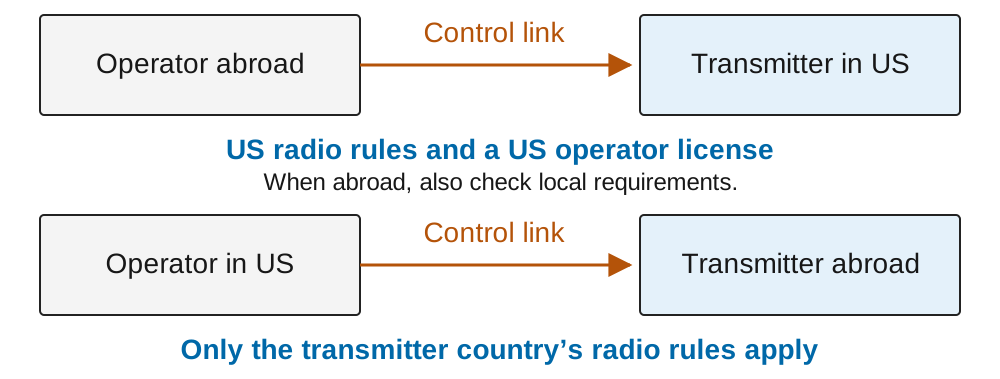
For radio operating privileges, focus on where the transmitter is located. The operator and transmitter may be in different countries:
Key Information:
- To operate a US station by remote control from outside the country, the control operator must hold a US operator/primary station license.
- When operating a station in South America by remote control over the internet from the US, only the remote station’s country’s rules govern the amateur radio operation.
In the first case, the station remains a US station, operating under FCC rules and the control operator’s US privileges. The country you’re in may restrict how you connect to a remote station, even if you hold a US license. Check the local rules too.
The reverse arrangement depends on permission from the transmitter’s country. A US General Class License does not automatically give you that permission. Get whatever approval that country requires and follow its frequency, power, identification, and control rules.
Taking a Radio Abroad #
Before taking a radio abroad, check the current rules with that country’s radio regulator or recognized national amateur organization. Permission can depend on your destination and license class; a US General Class License does not automatically allow you to operate there. Find out whether you need a separate permit. Confirm the required documents, call sign prefix, power limits, and allowed bands.
Whether you’re at home, at a remote control point, or visiting another country, know which station you’re allowed to control and what it may transmit. You also need to keep your license valid and know when new or upgraded privileges take effect.


 When the contact is with amateurs in any country except those whose administrations have notified the ITU that they object to such communications