



Section 9.4: Special Uses and Control #
The contacts in the previous chapter generally involved stations exchanging information with one another. A code-practice transmission or propagation beacon works differently: it sends something useful without expecting each listener to reply. A digital gateway may answer without an operator taking each turn at the keyboard.
These differences raise two separate questions: do the rules allow that transmission, and how is the station controlled? Even when a one-way transmission is allowed, automatic control needs separate permission.
Permitted One-Way Transmissions #
Amateur radio is not a general broadcasting service, but the rules permit specific kinds of one-way transmission. Morse code practice is one example:
Key Information: One-way transmissions to assist people learning International Morse code are permitted.
Amateur stations usually cannot retransmit signals from another radio service, but the rules allow this limited exception:
Key Information: All amateur stations may occasionally retransmit weather and propagation forecast information from US government stations.
For example, an operator may pass along government propagation information during an amateur net. This permission covers occasional retransmission as part of amateur communication.
Running a Propagation Beacon #
A beacon provides a signal that other operators can use to investigate a radio path:
Key Information: Observation of propagation and reception is a purpose of a beacon station.
How the beacon is controlled matters. The control point is where the control operator controls the station. With automatic control, devices and procedures keep the station within the rules without the control operator at the control point. The licensee and control operator remain responsible.
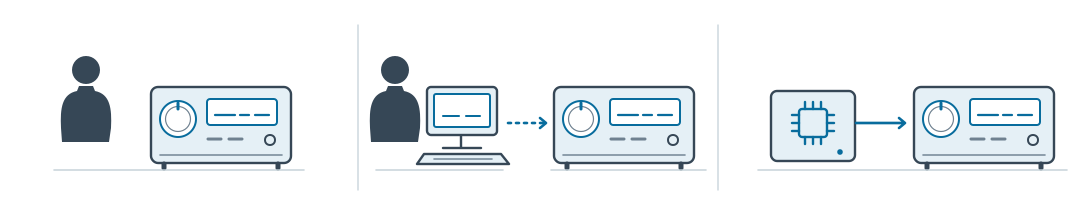
The FCC normally allows automatic control of HF beacons only within a specific range. Two other beacon limits apply:
Key Information:
- Automatically controlled beacon operation on HF is permitted between 28.20 and 28.30 MHz.
- The maximum beacon-station power is 100 watts PEP output.
- No more than one beacon station may transmit in the same band from the same station location.
An HF beacon heard outside that range may use another authorized form of control, operate under another country’s rules, or have a specific authorization.
The location restriction is per band. You can have beacons on different bands at one site, as long as each follows the other rules.
Automatically Controlled Digital Exchanges #
The gateway examples in the previous chapter use another form of automatic operation. A gateway might exchange signals with another automatically controlled station or answer an operator-controlled station. The rules differ for these two cases:
Key Information:
- Automatically controlled stations may communicate with other automatically controlled stations using RTTY or data on the 6-meter and shorter-wavelength bands, and in specified segments of some HF bands.
- When contacting an automatically controlled digital station outside the automatic-control segments, the station initiating the contact must be under local or remote control.
The stations must still use frequencies and emission types that the rules allow. “Six meters and shorter wavelengths” means the higher-frequency bands. On HF, Section 97.221(b) lists the permitted segments; check that list before setting up an unattended station.
Outside those HF segments, an automatically controlled station can answer only under stricter limits. Section 97.221(c) limits its response to a bandwidth of 500 Hz or less. This permission does not apply on the four 60-meter channels specified in Section 97.303(h). The rules must also allow that emission type on the chosen frequency. Local control at the calling station does not make every gateway mode legal everywhere. A wider automatic response still needs a segment where the rules allow it.
Using software is not, by itself, automatic control. An operator can use a computer to generate signals while remaining responsible for starting, supervising, and stopping the exchange.
Documenting a New Digital Protocol #
You can develop a new digital protocol, but it must meet the technical rules. Other operators also need access to its technical description:
Key Information: Before using a new digital protocol on the air, publicly document its technical characteristics.
Describe how the signal works, including its modulation, coding, timing, bandwidth, and any error-correction method. Also check the digital-code rules that apply under Section 97.309.
The radio service matters as well as the protocol. Even when two radios can exchange signals, the rules may not allow the contact:
Key Information: An amateur station may not communicate over its amateur radio link with non-licensed Wi-Fi stations anywhere in the 2.4 GHz band.
Here, the amateur transmission follows Part 97, while the Wi-Fi device follows Part 15—the FCC rules for unlicensed devices. Holding an amateur license does not automatically turn your laptop’s ordinary Wi-Fi connection into an amateur station.
You may still connect an amateur station’s computer to a home network or the internet. Separate network connections can support station control or an amateur data network.
Checking the Signal’s Technical Limits #
A digital protocol’s name is not enough to determine its power limit. Some use spread spectrum:
Key Information: The maximum PEP output for amateur spread spectrum transmissions is 10 watts.
That is a transmitter-output limit, unlike the ERP limits on 60 meters. Do not apply this 10-watt rule to every digital mode, or assume every Wi-Fi-derived system has the same emission type.
You also need to consider the message itself—especially when you transmit information for someone else or send it across an international border.



 Transmissions to assist with learning the International Morse code