



Section 6.1: AC Power and Protection #
Ham shacks come in all shapes and sizes—from a corner of the kitchen table to a dedicated room filled with equipment. Whenever you change your station’s power distribution, you’re making decisions that affect safety. That includes adding a simple power strip to charge your handheld or running a dedicated 240-volt circuit for an amplifier.
The Foundation: Understanding Your Home’s Power #
Before thinking about what your station needs, it helps to understand what’s already available in your home. Typical US residential service is split-phase 120/240V—the utility delivers 240 volts with a neutral connection halfway along the transformer winding. The voltage is 120 volts from either hot wire to neutral and 240 volts between the two hot wires. This gives you access to both voltages throughout your home:
- 120-volt circuits: Standard outlets powering most household items—lamps, televisions, computers, kitchen appliances, phone chargers.
- 240-volt circuits: High-power appliances like electric dryers, ovens/ranges, central air conditioners, water heaters, and EV chargers.
- 120/240-volt circuits: Appliances needing both—like a dryer that uses 240V for the heating element but 120V for the motor and timer, or a range that heats at 240V but runs its clock and lights at 120V.
Most ham stations run happily on standard 120-volt outlets. A typical 100-watt HF transceiver draws around 20-25 amps at 13.8 volts DC, which translates to only a few amps from a 120-volt wall outlet through its power supply. Check the supply’s AC input rating for the actual draw. Add a computer, monitor, and a few accessories, and you may still be well within what a single 15 or 20-amp circuit can handle—but count the other loads sharing that circuit too.
That said, there are reasons you might eventually want to expand—adding an amplifier that requires 240 volts, or simply wanting a dedicated circuit so the microwave doesn’t cause your radio to hiccup. The key is matching your station’s power system to your actual needs.
The Wires in Your Walls #
Before discussing circuit protection, it helps to understand what’s actually inside that electrical cable. A standard 120-volt circuit has three conductors. These are the usual colors, but color alone never proves a wire is safe:
- Hot (black): Carries voltage from the breaker panel. This is the dangerous one—it’s always “live” when the circuit is on.
- Neutral (white): Completes the circuit back to the panel. It carries current and normally sits close to ground potential, but it is not safe to touch merely because it is neutral.
- Ground (green or bare copper): A safety path that carries no current during normal operation, but provides a path for fault current back to the source so the fuse or breaker can disconnect power.
A four-wire 120/240-volt circuit has two hot wires (typically black and red) instead of one, plus neutral and ground. A load needing only 240 volts may use two hots and ground without a neutral. Understanding which wire does what matters when we talk about where to put fuses and why.
The National Electrical Code #
The standards for safe residential wiring aren’t arbitrary—they come from the National Electrical Code (NEC), which represents decades of hard-learned lessons about what causes fires and electrocutions. The NEC covers everything from wire sizing to outlet placement, and it applies to your ham station too.
Key Information: The National Electrical Code covers electrical safety of the station.
Local rules may adopt a particular NEC edition with amendments, so follow the rules for your area. If you’re adding circuits or making significant changes, work with a qualified electrician to get the job done right.
Circuit Protection and Wire Sizing #
Current flowing through undersized wire creates heat—potentially enough to melt insulation and start fires. Think of wire gauge like water pipes—too small and things back up, but with electricity the result is heat rather than pressure.
We can take advantage of this property by running current through a small wire carefully chosen to burn out and break if the current exceeds a safe level. This is called a fuse! Circuit breakers achieve the same protection using an electromagnetic or thermal mechanism to trip a switch; they have the advantage of being reusable—just reset them after fixing whatever caused the overload.
The NEC specifies which wire sizes are safe for different current loads. AWG means American Wire Gauge; a smaller number means a thicker wire:
Key Information:
- According to the National Electrical Code, the minimum wire size that may be used safely with a 20-ampere circuit breaker is AWG number 12.
- A 15-ampere fuse or circuit breaker would be appropriate to use with a circuit that uses AWG number 14 wiring.
Common Copper-Wire and Breaker Examples:
| Wire Size | Example Breaker | Typical Use |
|---|---|---|
| AWG 14 | 15 Amps | Standard lighting circuits, light-duty outlets. |
| AWG 12 | 20 Amps | Kitchen outlets, workshops, most ham stations. |
| AWG 10 | 30 Amps | Window AC units, some power tools. |
| AWG 8 | 40 Amps | Electric ranges, large appliances. |
| AWG 6 | 50 Amps | High-power equipment. |
These copper-wire examples assume suitable installation conditions; conductor material, insulation, terminals, and temperature can change the requirements. Long runs may need thicker wire to limit voltage drop. Use the applicable code and equipment instructions when sizing a real circuit.
Beyond sizing, where you place circuit protection matters. Get this wrong, and equipment might look dead while remaining dangerous.
Key Information: In a four-conductor 240 VAC circuit, only the hot wires should be connected to fuses or circuit breakers.
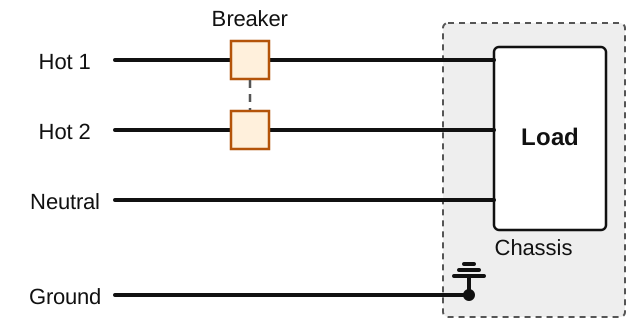
The logic is straightforward: interrupt the hot supply, and you disconnect the load from that source. Interrupting only the neutral can stop equipment from working while leaving it connected to a live hot wire.
On a 120-volt circuit, protection goes in its single hot conductor. For the four-wire 240-volt circuit, protect both hots, not neutral or ground. A common two-pole breaker disconnects both hots together when it trips. Equipment may still have stored energy or another supply, so a tripped breaker alone does not prove it is safe to touch.
GFCI Protection #
That outlet with the test and reset buttons could save your life. Ground Fault Circuit Interrupters detect when current isn’t returning the way it should and shut down the circuit in milliseconds.
On a 120-volt circuit in normal operation, all the current flowing out on the hot wire returns on the neutral. If some current takes a different path—directly to ground, through spilled water, into a person, etc.—the outgoing and returning currents no longer match. A GFCI detects this imbalance and opens its protected circuit. A receptacle GFCI need not trip the branch breaker; overload protection is a separate job.
Key Information: A ground fault circuit interrupter (GFCI) will disconnect AC power if current flows from one or more of the hot wires directly to ground.
GFCI protection is required in many locations, including bathrooms, kitchens, garages, outdoors, and basements. The exact requirements depend on the code adopted in your area. It can also add protection elsewhere in your shack.
Interlocks and Stored Energy #
High-voltage equipment can be dangerous even when unplugged—capacitors store energy that takes time to dissipate. Many power supplies and amplifiers include interlocks: switches that automatically disconnect dangerous voltages when the cabinet is opened.
Key Information: The purpose of a power supply interlock is to ensure that dangerous voltages are removed if the cabinet is opened.
The concept is simple—open the cover, break the supply circuit. But disconnecting that supply does not necessarily remove charge already stored in capacitors.
Interlocks provide an important layer of protection, but they’re not foolproof. Leave internal high-voltage work to someone trained for it. Proper servicing requires isolating the equipment from all power sources, following the manufacturer’s stored-energy procedure, and verifying the safe condition with suitable test equipment. Waiting a few minutes or trusting the interlock is not a substitute for verification.
Practical Considerations #
A few practical tips as you set up or expand your station:
- Know your circuits. Figure out which breakers control which outlets before you need that information in an emergency.
- Don’t overload outlets or power strips. Plug power strips directly into a wall outlet, not into another strip or an extension cord.
- Test before you trust. A simple outlet tester can find some common wiring faults—a worthwhile check for any outlet you’ll depend on, but not proof that every part of the circuit is safe.
- Consider a master shutoff. Being able to kill power to your entire station quickly can be valuable if something goes wrong.
The goal isn’t to over-engineer your power system, but to understand it well enough to use it safely and know when you need professional help.


 Electrical safety of the station