
The following questions are from the 2023–2027 General pool, with corrections and withdrawals included in this edition. The latest version of this book is available at hambook.org.
2023 - 2027 General Class Question Pool
Last updated: Jul 22, 2026
Subelement G1: COMMISSION’S RULES
General class control operator frequency privileges; primary and secondary allocations
G1A01:On which HF and/or MF amateur bands are there portions where General class licensees cannot transmit?
 80 meters, 40 meters, 20 meters, and 15 meters
G1A05:On which of the following frequencies are General class licensees prohibited from operating as control operator?
- 7.125 MHz to 7.175 MHz
G1A06:Which of the following applies when the FCC rules designate the amateur service as a secondary user on a band?
- Amateur stations must not cause harmful interference to primary users and must accept interference from primary users
G1A07:On which amateur frequencies in the 10-meter band may stations with a General class control operator transmit CW emissions?
- The entire band
G1A08:Which HF bands have segments exclusively allocated to Amateur Extra licensees?
- 80 meters, 40 meters, 20 meters, and 15 meters
G1A09:Which of the following frequencies is within the General class portion of the 15-meter band?
- 21300 kHz
G1A11:When General class licensees are not permitted to use the entire voice portion of a band, which portion of the voice segment is available to them?
- The upper frequency portion
Antenna structure limitations; good engineering and good amateur practice; beacon operation; prohibited transmissions; retransmitting radio signals
G1B01:What is the maximum height above ground for an antenna structure not near a public use airport without requiring notification to the FAA and registration with the FCC?
- 200 feet
G1B02:With which of the following conditions must beacon stations comply?
- No more than one beacon station may transmit in the same band from the same station location
G1B03:Which of the following is a purpose of a beacon station as identified in the FCC rules?
- Observation of propagation and reception
G1B04:Which of the following transmissions is permitted for all amateur stations?
- Occasional retransmission of weather and propagation forecast information from US government stations
G1B05:Which of the following one-way transmissions are permitted?
- Transmissions to assist with learning the International Morse code
G1B06:Under what conditions are state and local governments permitted to regulate amateur radio antenna structures?
- Amateur Service communications must be reasonably accommodated, and regulations must constitute the minimum practical to accommodate a legitimate purpose of the state or local entity
G1B07:What are the restrictions on the use of abbreviations or procedural signals in the amateur service?
- They may be used if they do not obscure the meaning of a message
G1B08:When is it permissible to communicate with amateur stations in countries outside the areas administered by the Federal Communications Commission?
- When the contact is with amateurs in any country except those whose administrations have notified the ITU that they object to such communications
G1B11:Who or what determines “good engineering and good amateur practice,” as applied to the operation of an amateur station in all respects not covered by the Part 97 rules?
- The FCC
Transmitter power regulations; data emission standards; 60-meter operation requirements
G1C01:What is the maximum transmitter power an amateur station may use on 10.140 MHz?
- 200 watts PEP output
G1C02:What is the maximum transmitter power an amateur station may use on the 12-meter band?
- 1500 watts PEP output
G1C03:What is the maximum bandwidth permitted by FCC rules for amateur radio stations transmitting on USB frequencies in the 60-meter band?
- 2.8 kHz
G1C04:Which of the following is required by the FCC rules when operating in the 60-meter band?
- If you are using an antenna other than a dipole, you must keep a record of the gain of your antenna
G1C05:What is the limit for transmitter power on the 28 MHz band for a General Class control operator?
- 1500 watts PEP output
G1C07:What must be done before using a new digital protocol on the air?
- Publicly document the technical characteristics of the protocol
G1C11:What measurement is specified by FCC rules that regulate maximum power?
- PEP output from the transmitter
Volunteer Examiners and Volunteer Examiner Coordinators; temporary identification; element credit; remote operation
G1D01:Who may receive partial credit for the elements represented by an expired amateur radio license?
- Any person who can demonstrate that they once held an FCC-issued General, Advanced, or Amateur Extra class license that was not revoked by the FCC
G1D02:What license examinations may you administer as an accredited Volunteer Examiner holding a General class operator license?
- Technician only
G1D03:On which of the following band segments may you operate if you are a Technician class operator and have an unexpired Certificate of Successful Completion of Examination (CSCE) for General class privileges?
- On any General or Technician class band segment
G1D04:Who must observe the administration of a Technician class license examination?
- At least three Volunteer Examiners of General class or higher
G1D05:When operating a US station by remote control from outside the country, what license is required of the control operator?
- A US operator/primary station license
G1D06:Until an upgrade to General class is shown in the FCC database, when must a Technician licensee identify with “AG” after their call sign?
- Whenever they operate using General class frequency privileges
G1D08:Which of the following criteria must be met for a non-US citizen to be an accredited Volunteer Examiner?
- The person must hold an FCC granted amateur radio license of General class or above
G1D09:How long is a Certificate of Successful Completion of Examination (CSCE) valid for exam element credit?
- 365 days
G1D10:What is the minimum age that one must be to qualify as an accredited Volunteer Examiner?
- 18 years
G1D11:What action is required to obtain a new General class license after a previously held license has expired and the two-year grace period has passed?
- The applicant must show proof of the appropriate expired license grant and pass the current Element 2 exam
G1D12:When operating a station in South America by remote control over the internet from the US, what regulations apply?
- Only those of the remote station’s country
Control categories; repeater regulations; third-party rules; ITU regions; automatically controlled digital station
G1E01:Which of the following would disqualify a third party from participating in sending a message via an amateur station?
- The third party’s amateur license has been revoked and not reinstated
G1E02:When may a 10-meter repeater retransmit the 2-meter signal from a station that has a Technician class control operator?
- Only if the 10-meter repeater control operator holds at least a General class license
G1E03:What is required to conduct communications with a digital station operating under automatic control outside the automatic control band segments?
- The station initiating the contact must be under local or remote control
G1E04:Which of the following conditions require a licensed amateur radio operator to take specific steps to avoid harmful interference to other users or facilities?
- A:When operating within one mile of an FCC Monitoring Station
- B:When using a band where the Amateur Service is secondary
- C:When a station is transmitting spread spectrum emissions
- All these choices are correct
G1E05:What are the restrictions on messages sent to a third party in a country with which there is a Third-Party Agreement?
- They must relate to amateur radio, or remarks of a personal character, or messages relating to emergencies or disaster relief
G1E06:The frequency allocations of which ITU region apply to radio amateurs operating in North and South America?
- Region 2
G1E07:In what part of the 2.4 GHz band may an amateur station communicate with non-licensed Wi-Fi stations?
- No part
G1E10:Why should an amateur operator normally avoid transmitting on 14.100, 18.110, 21.150, 24.930 and 28.200 MHz?
- A system of propagation beacon stations operates on those frequencies
G1E11:On what bands may automatically controlled stations transmitting RTTY or data emissions communicate with other automatically controlled digital stations?
- Anywhere in the 6-meter or shorter wavelength bands, and in limited segments of some of the HF bands
G1E12:When may third-party messages be transmitted via remote control?
- Under any circumstances in which third party messages are permitted by FCC rules
Subelement G2: OPERATING PROCEDURES
Phone operating procedures: USB/LSB conventions, breaking into a contact, transmitter setup for voice operation; answering DX stations
G2A01:Which mode is most commonly used for voice communications on frequencies of 14 MHz or higher?
- Upper sideband
G2A02:Which mode is most commonly used for voice communications on the 160-, 75-, and 40-meter bands?
- Lower sideband
G2A03:Which mode is most commonly used for SSB voice communications in the VHF and UHF bands?
- Upper sideband
G2A04:Which mode is most commonly used for voice communications on the 17- and 12-meter bands?
- Upper sideband
G2A05:Which mode of voice communication is most commonly used on the HF amateur bands?
- Single sideband
G2A06:Which of the following is an advantage of using single sideband, as compared to other analog voice modes on the HF amateur bands?
- Less bandwidth used and greater power efficiency
G2A07:Which of the following statements is true of single sideband (SSB)?
- Only one sideband is transmitted; the other sideband and carrier are suppressed
G2A09:Why do most amateur stations use lower sideband on the 160-, 75-, and 40-meter bands?
- It is commonly accepted amateur practice
G2A10:Which of the following statements is true of VOX operation versus PTT operation?
- It allows “hands free” operation
G2A11:Generally, who should respond to a station in the contiguous 48 states calling “CQ DX”?
- Any stations outside the lower 48 states
G2A12:What control is typically adjusted for proper ALC setting on a single sideband transceiver?
- Transmit audio or microphone gain
Operating effectively; band plans; drills and emergencies; RACES operation
G2B01:Which of the following is true concerning access to frequencies?
- Except during emergencies, no amateur station has priority access to any frequency
G2B02:What is the first thing you should do if you are communicating with another amateur station and hear a station in distress break in?
- Acknowledge the station in distress and determine what assistance may be needed
G2B03:What is good amateur practice if propagation changes during a contact creating interference from other stations using the frequency?
- Attempt to resolve the interference problem with the other stations in a mutually acceptable manner
G2B04:When selecting a CW transmitting frequency, what minimum separation from other stations should be used to minimize interference to stations on adjacent frequencies?
- 150 Hz to 500 Hz
G2B05:When selecting an SSB transmitting frequency, what minimum separation should be used to minimize interference to stations on adjacent frequencies?
- 2 kHz to 3 kHz
G2B06:How can you avoid harmful interference on an apparently clear frequency before calling CQ on CW or phone?
- Send “QRL?” on CW, followed by your call sign; or, if using phone, ask if the frequency is in use, followed by your call sign
G2B07:Which of the following complies with commonly accepted amateur practice when choosing a frequency on which to initiate a call?
- Follow the voluntary band plan
G2B08:What is the voluntary band plan restriction for US stations transmitting within the 48 contiguous states in the 50.1 MHz to 50.125 MHz band segment?
- Only contacts with stations not within the 48 contiguous states
G2B09:Who may be the control operator of an amateur station transmitting in RACES to assist relief operations during a disaster?
- Only a person holding an FCC-issued amateur operator license
G2B10:Which of the following is good amateur practice for net management?
- Have a backup frequency in case of interference or poor conditions
G2B11:How often may RACES training drills and tests be routinely conducted without special authorization?
- No more than 1 hour per week
CW operating procedures and procedural signals; Q signals; full break-in
G2C01:Which of the following describes full break-in CW operation (QSK)?
- Transmitting stations can receive between code characters and elements
G2C03:What does it mean when a CW operator sends “KN” at the end of a transmission?
- Listening only for a specific station or stations
G2C05:What is the best speed to use when answering a CQ in Morse code?
- The fastest speed at which you are comfortable copying, but no faster than the CQ
G2C06:What does the term “zero beat” mean in CW operation?
- Matching the transmit frequency to the frequency of a received signal
Volunteer Monitor Program; HF operations
G2D01:What is the Volunteer Monitor Program?
- Amateur volunteers who are formally enlisted to monitor the airwaves for rules violations
G2D02:Which of the following are objectives of the Volunteer Monitor Program?
- To encourage amateur radio operators to self-regulate and comply with the rules
G2D03:What procedure may be used by Volunteer Monitors to localize a station whose continuous carrier is holding a repeater on in their area?
- Compare beam headings on the repeater input from their home locations with that of other Volunteer Monitors
G2D04:Which of the following describes an azimuthal projection map?
- A map that shows true bearings and distances from a specific location
G2D05:Which of the following indicates that you are looking for an HF contact with any station?
- Repeat “CQ” a few times, followed by “this is,” then your call sign a few times, then pause to listen, repeat as necessary
G2D06:How is a directional antenna pointed when making a “long-path” contact with another station?
- 180 degrees from the station’s short-path heading
G2D07:Which of the following are examples of the NATO Phonetic Alphabet?
- Alpha, Bravo, Charlie, Delta
G2D08:Why do many amateurs keep a station log?
- To help with a reply if the FCC requests information about your station
G2D09:Which of the following is required when participating in a contest on HF frequencies?
- Identify your station according to normal FCC regulations
G2D11:Why are signal reports typically exchanged at the beginning of an HF contact?
- To allow each station to operate according to conditions
Digital mode operating procedures
G2E03:What symptoms may result from other signals interfering with a PACTOR or VARA transmission?
- A:Frequent retries or timeouts
- B:Long pauses in message transmission
- C:Failure to establish a connection between stations
- All these choices are correct
G2E04:Which of the following is good practice when choosing a transmitting frequency to answer a station calling CQ using FT8?
- Find a clear frequency during the alternate time slot to the calling station
G2E07:Which of the following is required when using FT8?
- Computer time accurate to within approximately 1 second
G2E08:In what segment of the 20-meter band are most digital mode operations commonly found?
- Between 14.070 MHz and 14.100 MHz
G2E09:How do you join a contact between two stations using the PACTOR protocol?
- Joining an existing contact is not possible, PACTOR connections are limited to two stations
G2E10:Which of the following is a way to establish contact with a digital messaging system gateway station?
- Transmit a connect message on the station’s published frequency
G2E11:What is the primary purpose of an Amateur Radio Emergency Data Network (AREDN) mesh network?
- To provide high-speed data services during an emergency or community event
G2E12:Which of the following describes Winlink?
- A:An amateur radio wireless network to send and receive email on the internet
- B:A form of Packet Radio
- C:A wireless network capable of both VHF and HF band operation
- All these choices are correct
G2E14:What could be wrong if you cannot decode an RTTY or other FSK signal even though it is apparently tuned in properly?
- A:The mark and space frequencies may be reversed
- B:You may have selected the wrong baud rate
- C:You may be listening on the wrong sideband
- All these choices are correct
Subelement G3: RADIO WAVE PROPAGATION
Sunspots and solar radiation; geomagnetic field and stability indices
G3A01:How does a higher sunspot number affect HF propagation?
- Higher sunspot numbers generally indicate a greater probability of good propagation at higher frequencies
G3A02:What effect does a sudden ionospheric disturbance have on the daytime ionospheric propagation?
- It disrupts signals on lower frequencies more than those on higher frequencies
G3A03:Approximately how long does it take the increased ultraviolet and X-ray radiation from a solar flare to affect radio propagation on Earth?
- 8 minutes
G3A04:Which of the following are the least reliable bands for long-distance communications during periods of low solar activity?
- 15 meters, 12 meters, and 10 meters
G3A05:What is the solar flux index?
- A measure of solar radiation with a wavelength of 10.7 centimeters
G3A07:At what point in the solar cycle does the 20-meter band usually support worldwide propagation during daylight hours?
- At any point
G3A09:How can high geomagnetic activity benefit radio communications?
- Creates auroras that can reflect VHF signals
G3A10:What causes HF propagation conditions to vary periodically in a 26- to 28-day cycle?
- Rotation of the Sun’s surface layers around its axis
G3A11:How long does it take a coronal mass ejection to affect radio propagation on Earth?
- 15 hours to several days
G3A14:How is long distance radio communication usually affected by the charged particles that reach Earth from solar coronal holes?
- HF communication is disturbed
Maximum Usable Frequency; Lowest Usable Frequency; short path and long path propagation; determining propagation conditions; ionospheric refraction
G3B01:What is a characteristic of skywave signals arriving at your location by both short-path and long-path propagation?
- A slightly delayed echo might be heard
G3B02:What factors affect the MUF?
- A:Path distance and location
- B:Time of day and season
- C:Solar radiation and ionospheric disturbances
- All these choices are correct
G3B03:Which frequency will have the least attenuation for long-distance skip propagation?
- Just below the MUF
G3B04:Which of the following is a way to determine current propagation on a desired band from your station?
- Use a network of automated receiving stations on the internet to see where your transmissions are being received
G3B05:How does the ionosphere affect radio waves with frequencies below the MUF and above the LUF?
- They are refracted back to Earth
G3B06:What usually happens to radio waves with frequencies below the LUF?
- They are attenuated before reaching the destination
G3B07:What does LUF stand for?
- The Lowest Usable Frequency for communications between two specific points
G3B09:What is the approximate maximum distance along the Earth’s surface normally covered in one hop using the F2 region?
- 2,500 miles
G3B10:What is the approximate maximum distance along the Earth’s surface normally covered in one hop using the E region?
- 1,200 miles
G3B11:What happens to HF propagation when the LUF exceeds the MUF?
- Propagation via ordinary skywave communications is not possible over that path
G3B12:Which of the following is typical of the lower HF frequencies during the summer?
- High levels of atmospheric noise or static
Ionospheric regions; critical angle and frequency; HF scatter; near vertical incidence skywave (NVIS)
G3C02:What is meant by the term “critical frequency” at a given incidence angle?
- The highest frequency which is refracted back to Earth
G3C03:Why is skip propagation via the F2 region longer than that via the other ionospheric regions?
- Because it is the highest
G3C04:What does the term “critical angle” mean, as applied to radio wave propagation?
- The highest takeoff angle that will return a radio wave to Earth under specific ionospheric conditions
G3C05:Why is long-distance communication on the 40-, 60-, 80-, and 160-meter bands more difficult during the day?
- The D region absorbs signals at these frequencies during daylight hours
G3C07:What makes HF scatter signals often sound distorted?
- Energy is scattered into the skip zone through several different paths
G3C08:Why are HF scatter signals in the skip zone usually weak?
- Only a small part of the signal energy is scattered into the skip zone
G3C09:What type of propagation allows signals to be heard in the transmitting station’s skip zone?
- Scatter
G3C10:What is near vertical incidence skywave (NVIS) propagation?
- Short distance MF or HF propagation at high elevation angles
G3C11:Which ionospheric region is the most absorbent of signals below 10 MHz during daylight hours?
- The D region
Subelement G4: AMATEUR RADIO PRACTICES
Station configuration and operation
G4A01:What is the purpose of the notch filter found on many HF transceivers?
- To reduce interference from carriers in the receiver passband
G4A02:What is the benefit of using the opposite or “reverse” sideband when receiving CW?
- It may be possible to reduce or eliminate interference from other signals
G4A04:What is the effect on plate current of the correct setting of a vacuum-tube RF power amplifier’s TUNE control?
- A pronounced dip
G4A05:Why is automatic level control (ALC) used with an RF power amplifier?
- To prevent excessive drive
G4A06:What is the purpose of an antenna tuner?
- Increase power transfer from the transmitter to the feed line
G4A07:What happens as a receiver’s noise reduction control level is increased?
- Received signals may become distorted
G4A08:What is the correct adjustment for the LOAD or COUPLING control of a vacuum tube RF power amplifier?
- Desired power output without exceeding maximum allowable plate current
G4A09:What is the purpose of delaying RF output after activating a transmitter’s keying line to an external amplifier?
- To allow time for the amplifier to switch the antenna between the transceiver and the amplifier output
G4A10:What is the function of an electronic keyer?
- Automatic generation of dots and dashes for CW operation
G4A11:Why should the ALC system be inactive when transmitting AFSK data signals?
- The ALC action distorts the signal
G4A12:Which of the following is a common use of the dual-VFO feature on a transceiver?
- To transmit on one frequency and listen on another
G4A13:What is the purpose of using a receive attenuator?
- To prevent receiver overload from strong incoming signals
Tests and test equipment
G4B01:What item of test equipment contains horizontal and vertical channel amplifiers?
- An oscilloscope
G4B02:Which of the following is an advantage of an oscilloscope versus a digital voltmeter?
- Complex waveforms can be measured
G4B03:Which of the following is the best instrument to use for checking the keying waveform of a CW transmitter?
- An oscilloscope
G4B04:What signal source is connected to the vertical input of an oscilloscope when checking the RF envelope pattern of a transmitted signal?
- The attenuated RF output of the transmitter
G4B05:Why do voltmeters have high input impedance?
- It decreases the loading on circuits being measured
G4B06:What is an advantage of a digital multimeter as compared to an analog multimeter?
- Higher precision
G4B09:When is an analog multimeter preferred to a digital multimeter?
- When adjusting circuits for maximum or minimum values
G4B11:Which of the following must be connected to an antenna analyzer when it is being used for SWR measurements?
- Antenna and feed line
G4B12:What effect can strong signals from nearby transmitters have on an antenna analyzer?
- Received power that interferes with SWR readings
Interference to consumer electronics; grounding and bonding
G4C01:Which of the following might be useful in reducing RF interference to audio frequency circuits?
- Bypass capacitor
G4C02:Which of the following could be a cause of interference covering a wide range of frequencies?
- Arcing at a poor electrical connection
G4C03:What sound is heard from an audio device experiencing RF interference from a single sideband phone transmitter?
- Distorted speech
G4C04:What sound is heard from an audio device experiencing RF interference from a CW transmitter?
- On-and-off humming or clicking
G4C05:What is a possible cause of high voltages that produce RF burns?
- The ground wire has high impedance on that frequency
G4C06:What is a possible effect of a resonant ground connection?
- High RF voltages on the enclosures of station equipment
G4C07:Why should soldered joints not be used in lightning protection ground connections?
- A soldered joint will likely be destroyed by the heat of a lightning strike
G4C08:Which of the following would reduce RF interference caused by common-mode current on an audio cable?
- Place a ferrite choke on the cable
G4C10:What could be a symptom caused by a ground loop in your station’s audio connections?
- You receive reports of “hum” on your station’s transmitted signal
G4C11:What technique helps to minimize RF “hot spots” in an amateur station?
- Bonding all equipment enclosures together
G4C12:Why must all metal enclosures of station equipment be grounded?
- It ensures that hazardous voltages cannot appear on the chassis
Speech processors; S meters; sideband operation near band edges
G4D01:What is the purpose of a speech processor in a transceiver?
- Increase the apparent loudness of transmitted voice signals
G4D03:What is the effect of an incorrectly adjusted speech processor?
- A:Distorted speech
- B:Excess intermodulation products
- C:Excessive background noise
- All these choices are correct
G4D05:How does a signal that reads 20 dB over S9 compare to one that reads S9 on a receiver, assuming a properly calibrated S meter?
- It is 100 times more powerful
G4D07:How much must the power output of a transmitter be raised to change the S meter reading on a distant receiver from S8 to S9?
- Approximately 4 times
G4D08:What frequency range is occupied by a 3 kHz LSB signal when the displayed carrier frequency is set to 7.178 MHz?
- 7.175 MHz to 7.178 MHz
G4D09:What frequency range is occupied by a 3 kHz USB signal with the displayed carrier frequency set to 14.347 MHz?
- 14.347 MHz to 14.350 MHz
G4D10:How close to the lower edge of a band’s phone segment should your displayed carrier frequency be when using 3 kHz wide LSB?
- At least 3 kHz above the edge of the segment
G4D11:How close to the upper edge of a band’s phone segment should your displayed carrier frequency be when using 3 kHz wide USB?
- At least 3 kHz below the edge of the band
Mobile and portable HF stations; alternative energy source operation
G4E01:What is the purpose of a capacitance hat on a mobile antenna?
- To electrically lengthen a physically short antenna
G4E02:What is the purpose of a corona ball on an HF mobile antenna?
- To reduce RF voltage discharge from the tip of the antenna while transmitting
G4E03:Which of the following direct, fused power connections would be the best for a 100-watt HF mobile installation?
- To the battery using heavy-gauge wire
G4E04:Why should DC power for a 100-watt HF transceiver not be supplied by a vehicle’s auxiliary power socket?
- The socket’s wiring may be inadequate for the current drawn by the transceiver
G4E05:Which of the following most limits an HF mobile installation?
- Efficiency of the electrically short antenna
G4E06:What is one disadvantage of using a shortened mobile antenna as opposed to a full-size antenna?
- Operating bandwidth may be very limited
G4E07:Which of the following may cause receive interference to an HF transceiver installed in a vehicle?
- A:The battery charging system
- B:The fuel delivery system
- C:The control computers
- All these choices are correct
G4E08:In what configuration are the individual cells in a solar panel connected together?
- Series-parallel
G4E09:What is the approximate open-circuit voltage from a fully illuminated silicon photovoltaic cell?
- 0.5 VDC
G4E10:Why should a series diode be connected between a solar panel and a storage battery that is being charged by the panel?
- To prevent discharge of the battery through the panel during times of low or no illumination
G4E11:What precaution should be taken when connecting a solar panel to a lithium iron phosphate battery?
- The solar panel must have a charge controller
Subelement G5: ELECTRICAL PRINCIPLES
Reactance; inductance; capacitance; impedance; impedance transformation; resonance
G5A01:What happens when inductive and capacitive reactance are equal in a series LC circuit?
- Resonance causes impedance to be very low
G5A02:What is reactance?
- Opposition to the flow of alternating current caused by capacitance or inductance
G5A03:Which of the following is opposition to the flow of alternating current in an inductor?
- Reactance
G5A04:Which of the following is opposition to the flow of alternating current in a capacitor?
- Reactance
G5A05:How does an inductor react to AC?
- As the frequency of the applied AC increases, the reactance increases
G5A06:How does a capacitor react to AC?
- As the frequency of the applied AC increases, the reactance decreases
G5A10:Which of the following devices can be used for impedance matching at radio frequencies?
- A:A transformer
- B:A Pi-network
- C:A length of transmission line
- All these choices are correct
The decibel; current and voltage dividers; electrical power calculations; sine wave root-mean-square (RMS) values; PEP calculations
G5B02:How does the total current relate to the individual currents in a circuit of parallel resistors?
- It equals the sum of the currents through each branch
G5B03:How many watts of electrical power are consumed if 400 VDC is supplied to an 800-ohm load?
- 200 watts
G5B04:How many watts of electrical power are consumed by a 12 VDC light bulb that draws 0.2 amperes?
- 2.4 watts
G5B05:How many watts are consumed when a current of 7.0 milliamperes flows through a 1,250-ohm resistance?
- Approximately 61 milliwatts
G5B07:What value of an AC signal produces the same power dissipation in a resistor as a DC voltage of the same value?
- The RMS value
G5B13:What is the output PEP of an unmodulated carrier if the average power is 1060 watts?
- 1060 watts
Resistors, capacitors, and inductors in series and parallel; transformers
G5C01:What causes a voltage to appear across the secondary winding of a transformer when an AC voltage source is connected across its primary winding?
- Mutual inductance
G5C02:What is the output voltage if an input signal is applied to the secondary winding of a 4:1 voltage step-down transformer instead of the primary winding?
- The input voltage is multiplied by 4
G5C03:What is the total resistance of a 10-, a 20-, and a 50-ohm resistor connected in parallel?
- 5.9 ohms
G5C05:Why is the primary winding wire of a voltage step-up transformer usually a larger size than that of the secondary winding?
- To accommodate the higher current of the primary
G5C06:What is the voltage output of a transformer with a 500-turn primary and a 1500-turn secondary when 120 VAC is applied to the primary?
- 360 volts
G5C07:What transformer turns ratio matches an antenna’s 600-ohm feed point impedance to a 50-ohm coaxial cable?
- 3.5 to 1
G5C08:What is the equivalent capacitance of two 5.0-nanofarad capacitors and one 750-picofarad capacitor connected in parallel?
- 10.750 nanofarads
G5C09:What is the capacitance of three 100-microfarad capacitors connected in series?
- 33.3 microfarads
G5C10:What is the inductance of three 10-millihenry inductors connected in parallel?
- 3.3 millihenries
G5C11:What is the inductance of a circuit with a 20-millihenry inductor connected in series with a 50-millihenry inductor?
- 70 millihenries
G5C12:What is the capacitance of a 20-microfarad capacitor connected in series with a 50-microfarad capacitor?
- 14.3 microfarads
G5C13:Which of the following components should be added to a capacitor to increase the capacitance?
- A capacitor in parallel
G5C14:Which of the following components should be added to an inductor to increase the inductance?
- An inductor in series
Subelement G6: CIRCUIT COMPONENTS
Resistors; capacitors; inductors; rectifiers; solid-state diodes and transistors; vacuum tubes; batteries
G6A01:What is the minimum allowable discharge voltage for maximum life of a standard 12-volt lead-acid battery?
- 10.5 volts
G6A04:Which of the following is characteristic of an electrolytic capacitor?
- High capacitance for a given volume
G6A06:Why should wire-wound resistors not be used in RF circuits?
- The resistor’s inductance could make circuit performance unpredictable
G6A08:Which of the following is characteristic of low voltage ceramic capacitors?
- Comparatively low cost
G6A09:Which of the following describes MOSFET construction?
- The gate is separated from the channel by a thin insulating layer
G6A10:Which element of a vacuum tube regulates the flow of electrons between cathode and plate?
- Control grid
G6A11:What happens when an inductor is operated above its self-resonant frequency?
- It becomes capacitive
G6A12:What is the primary purpose of a screen grid in a vacuum tube?
- To reduce grid-to-plate capacitance
Analog and digital integrated circuits (ICs); microwave ICs (MMICs); display devices; RF connectors; ferrite cores
G6B01:What determines the performance of a ferrite core at different frequencies?
- The composition, or “mix,” of materials used
G6B03:Which of the following is an advantage of CMOS integrated circuits compared to TTL integrated circuits?
- Low power consumption
G6B05:What is an advantage of using a ferrite core toroidal inductor?
- A:Large values of inductance may be obtained
- B:The magnetic properties of the core may be optimized for a specific range of frequencies
- C:Most of the magnetic field is contained in the core
- All these choices are correct
G6B07:Which of the following describes a type N connector?
- A moisture-resistant RF connector useful to 10 GHz
G6B10:How does a ferrite bead or core reduce common-mode RF current on the shield of a coaxial cable?
- By creating an impedance in the current’s path
G6B12:Which of these connector types is commonly used for low frequency or dc signal connections to a transceiver?
- RCA Phono
Subelement G7: PRACTICAL CIRCUITS
Power supplies; schematic symbols
G7A01:What is the function of a power supply bleeder resistor?
- It discharges the filter capacitors when power is removed
G7A02:Which of the following components are used in a power supply filter network?
- Capacitors and inductors
G7A07:What is the output waveform of an unfiltered full-wave rectifier connected to a resistive load?
- A series of DC pulses at twice the frequency of the AC input
G7A08:Which of the following is characteristic of a switchmode power supply as compared to a linear power supply?
- High-frequency operation allows the use of smaller components
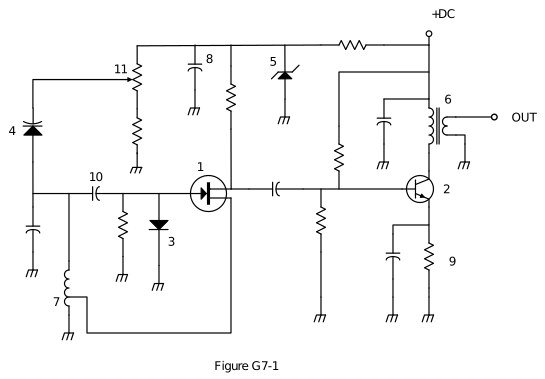
Digital circuits; amplifiers and oscillators
G7B03:Which of the following describes the function of a two-input AND gate?
- Output is high only when both inputs are high
G7B06:What is a shift register?
- A clocked array of circuits that passes data in steps along the array
G7B07:Which of the following are basic components of a sine wave oscillator?
- A filter and an amplifier operating in a feedback loop
G7B08:How is the efficiency of an RF power amplifier determined?
- Divide the RF output power by the DC input power
G7B09:What determines the frequency of an LC oscillator?
- The inductance and capacitance in the tank circuit
G7B10:Which of the following describes a linear amplifier?
- An amplifier in which the output preserves the input waveform
G7B11:For which of the following modes is a Class C power stage appropriate for amplifying a modulated signal?
- FM
Transceiver design; filters; oscillators; digital signal processing (DSP)
G7C03:What is one reason to use an impedance matching transformer at a transmitter output?
- To present the desired impedance to the transmitter and feed line
G7C04:How is a product detector used?
- Used in a single sideband receiver to extract the modulated signal
G7C05:Which of the following is characteristic of a direct digital synthesizer (DDS)?
- Variable output frequency with the stability of a crystal oscillator
G7C06:Which of the following is an advantage of a digital signal processing (DSP) filter compared to an analog filter?
- A wide range of filter bandwidths and shapes can be created
G7C08:Which parameter affects receiver sensitivity?
- A:Input amplifier gain
- B:Demodulator stage bandwidth
- C:Input amplifier noise figure
- All these choices are correct
G7C09:What is the phase difference between the I and Q RF signals that software-defined radio (SDR) equipment uses for modulation and demodulation?
- 90 degrees
G7C10:What is an advantage of using I-Q modulation with software-defined radios (SDRs)?
- All types of modulation can be created with appropriate processing
G7C11:Which of these functions is performed by software in a software-defined radio (SDR)?
- A:Filtering
- B:Detection
- C:Modulation
- All these choices are correct
G7C12:What is the frequency above which a low-pass filter’s output power is less than half the input power?
- Cutoff frequency
G7C13:What term specifies a filter’s maximum ability to reject signals outside its passband?
- Ultimate rejection
G7C14:The bandwidth of a band-pass filter is measured between what two frequencies?
- Upper and lower half-power
Subelement G8: SIGNALS AND EMISSIONS
Carriers and modulation: AM, FM, and single sideband; modulation envelope; digital modulation; overmodulation; link budgets and link margins
G8A01:How is direct binary FSK modulation generated?
- By changing an oscillator’s frequency directly with a digital control signal
G8A02:What is the name of the process that changes the phase angle of an RF signal to convey information?
- Phase modulation
G8A03:What is the name of the process that changes the instantaneous frequency of an RF wave to convey information?
- Frequency modulation
G8A04:What emission is produced by a reactance modulator connected to a transmitter RF amplifier stage?
- Phase modulation
G8A05:What type of modulation varies the instantaneous power level of the RF signal?
- Amplitude modulation
G8A06:Which of the following is characteristic of QPSK31?
- A:It is sideband sensitive
- B:Its encoding provides error correction
- C:Its bandwidth is approximately the same as BPSK31
- All these choices are correct
G8A10:What is meant by the term “flat-topping,” when referring to an amplitude-modulated phone signal?
- Signal distortion caused by excessive drive or speech levels
G8A11:What is the modulation envelope of an AM signal?
- The waveform created by connecting the peak values of the modulated signal
G8A12:What is QPSK modulation?
- Modulation in which digital data is transmitted using 0-, 90-, 180- and 270-degrees phase shift to represent pairs of bits
G8A13:What is a link budget?
- The sum of transmit power and antenna gains minus system losses as seen at the receiver
G8A14:What is link margin?
- The difference between received power level and minimum required signal level at the input to the receiver
Frequency changing; bandwidths of various modes; deviation; intermodulation
G8B01:Which mixer input is varied or tuned to convert signals of different frequencies to an intermediate frequency (IF)?
- Local oscillator
G8B02:What is the term for interference from a signal at twice the IF frequency from the desired signal?
- Image response
G8B04:What is the stage in a VHF FM transmitter that generates a harmonic of a lower frequency signal to reach the desired operating frequency?
- Multiplier
G8B06:What is the total bandwidth of an FM phone transmission having 5 kHz deviation and 3 kHz modulating frequency?
- 16 kHz
G8B07:What is the frequency deviation for a 12.21 MHz reactance modulated oscillator in a 5 kHz deviation, 146.52 MHz FM phone transmitter?
- 416.7 Hz
G8B08:Why is it important to know the duty cycle of the mode you are using when transmitting?
- Some modes have high duty cycles that could exceed the transmitter’s average power rating
G8B09:Why is it good to match receiver bandwidth to the bandwidth of the operating mode?
- It results in the best signal-to-noise ratio
G8B10:What is the relationship between transmitted symbol rate and bandwidth?
- Higher symbol rates require wider bandwidth
G8B11:What combination of a mixer’s Local Oscillator (LO) and RF input frequencies is found in the output?
- The sum and difference
G8B12:What process combines two signals in a non-linear circuit to produce unwanted spurious outputs?
- Intermodulation
G8B13:Which of the following is an odd-order intermodulation product of frequencies F1 and F2?
- 2F1-F2
Digital emission modes
G8C05:In an ARQ mode, what is meant by a NAK response to a transmitted packet?
- Request retransmission of the packet
G8C06:What action results from a failure to exchange information due to excessive transmission attempts when using an ARQ mode?
- The connection is dropped
G8C07:Which of the following narrow-band digital modes can receive signals with very low signal-to-noise ratios?
- FT8
G8C08:Which of the following statements is true about PSK31?
- Upper case letters use longer Varicode bit sequences and thus slow down transmission
G8C09:Which is true of mesh network microwave nodes?
- If one node fails, a packet may still reach its target station via an alternate node
G8C10:How does forward error correction (FEC) allow the receiver to correct data errors?
- By transmitting redundant information with the data
G8C11:How are the two separate frequencies of a Frequency Shift Keyed (FSK) signal identified?
- Mark and space
G8C13:What is indicated on a waterfall display by one or more vertical lines on either side of a data mode or RTTY signal?
- Overmodulation
G8C14:Which of the following describes a waterfall display?
- Frequency is horizontal, signal strength is intensity, time is vertical
G8C15:What does an FT8 signal report of +3 mean?
- The signal-to-noise ratio is equivalent to +3dB in a 2.5 kHz bandwidth
Subelement G9: ANTENNAS AND FEED LINES
Feed lines: characteristic impedance and attenuation; standing wave ratio (SWR) calculation, measurement, and effects; antenna feed point matching
G9A01:Which of the following factors determine the characteristic impedance of a parallel conductor feed line?
- The distance between the centers of the conductors and the radius of the conductors
G9A02:What is the relationship between high standing wave ratio (SWR) and transmission line loss?
- High SWR increases loss in a lossy transmission line
G9A04:What causes reflected power at an antenna’s feed point?
- A difference between feed line impedance and antenna feed point impedance
G9A05:How does the attenuation of coaxial cable change with increasing frequency?
- Attenuation increases
G9A07:What must be done to prevent standing waves on a feed line connected to an antenna?
- The antenna feed point impedance must be matched to the characteristic impedance of the feed line
G9A08:If the SWR on an antenna feed line is 5:1, and a matching network at the transmitter end of the feed line is adjusted to present a 1:1 SWR to the transmitter, what is the resulting SWR on the feed line?
- 5:1
G9A09:What standing wave ratio results from connecting a 50-ohm feed line to a 200-ohm resistive load?
- 4:1
G9A10:What standing wave ratio results from connecting a 50-ohm feed line to a 10-ohm resistive load?
- 5:1
G9A11:What is the effect of transmission line loss on SWR measured at the input to the line?
- Higher loss reduces SWR measured at the input to the line
Basic dipole and monopole antennas
G9B01:What is a characteristic of a random-wire HF antenna connected directly to the transmitter?
- Station equipment may carry significant RF current
G9B02:Which of the following is a common way to adjust the feed point impedance of an elevated quarter-wave ground-plane vertical antenna to be approximately 50 ohms?
- Slope the radials downward
G9B03:Which of the following best describes the radiation pattern of a quarter-wave ground-plane vertical antenna?
- Omnidirectional in azimuth
G9B04:What is the radiation pattern of a dipole antenna in free space in a plane containing the conductor?
- It is a figure-eight at right angles to the antenna
G9B05:How does antenna height affect the azimuthal radiation pattern of a horizontal dipole HF antenna at elevation angles higher than about 45 degrees?
- If the antenna is less than 1/2 wavelength high, the azimuthal pattern is almost omnidirectional
G9B06:Where should the radial wires of a ground-mounted vertical antenna system be placed?
- On the surface or buried a few inches below the ground
G9B07:How does the feed point impedance of a horizontal 1/2 wave dipole antenna change as the antenna height is reduced to 1/10 wavelength above ground?
- It steadily decreases
G9B08:How does the feed point impedance of a 1/2 wave dipole change as the feed point is moved from the center toward the ends?
- It steadily increases
G9B09:Which of the following is an advantage of using a horizontally polarized as compared to a vertically polarized HF antenna?
- Lower ground losses
Directional antennas
G9C01:Which of the following would increase the bandwidth of a Yagi antenna?
- Larger-diameter elements
G9C03:How do the lengths of a three-element Yagi reflector and director compare to that of the driven element?
- The reflector is longer, and the director is shorter
G9C04:How does antenna gain in dBi compare to gain stated in dBd for the same antenna?
- Gain in dBi is 2.15 dB higher
G9C05:What is the primary effect of increasing boom length and adding directors to a Yagi antenna?
- Gain increases
G9C07:What does “front-to-back ratio” mean in reference to a Yagi antenna?
- The power radiated in the major lobe compared to that in the opposite direction
G9C08:What is meant by the “main lobe” of a directive antenna?
- The direction of maximum radiated field strength from the antenna
G9C09:In free space, how does the gain of two three-element, horizontally polarized Yagi antennas spaced vertically 1/2 wavelength apart typically compare to the gain of a single three-element Yagi?
- Approximately 3 dB higher
G9C10:Which of the following can be adjusted to optimize forward gain, front-to-back ratio, or SWR bandwidth of a Yagi antenna?
- A:The physical length of the boom
- B:The number of elements on the boom
- C:The spacing of each element along the boom
- All these choices are correct
G9C11:What is a beta or hairpin match?
- A shorted transmission line stub placed at the feed point of a Yagi antenna to provide impedance matching
G9C12:Which of the following is a characteristic of using a gamma match with a Yagi antenna?
- It does not require the driven element to be insulated from the boom
Specialized antenna types and applications
G9D01:Which of the following antenna types will be most effective as a near vertical incidence skywave (NVIS) antenna for short-skip communications on 40 meters during the day?
- A horizontal dipole placed between 1/10 and 1/4 wavelength above the ground
G9D03:In which direction is the maximum radiation from a VHF/UHF “halo” antenna?
- Omnidirectional in the plane of the halo
G9D05:What is an advantage of vertically stacking horizontally polarized Yagi antennas?
- It narrows the main lobe in elevation
G9D07:Which of the following describes a log-periodic antenna?
- Element length and spacing vary logarithmically along the boom
G9D08:How does a “screwdriver” mobile antenna adjust its feed point impedance?
- By varying the base loading inductance
G9D10:In which direction or directions does an electrically small loop (less than 1/10 wavelength in circumference) have nulls in its radiation pattern?
- Broadside to the loop
G9D11:Which of the following is a disadvantage of multiband antennas?
- They have poor harmonic rejection
Subelement G0: ELECTRICAL AND RF SAFETY
RF safety principles, rules, and guidelines; routine station evaluation
G0A02:Which of the following is used to determine RF exposure from a transmitted signal?
- A:Its duty cycle
- B:Its frequency
- C:Its power density
- All these choices are correct
G0A03:How can you determine that your station complies with FCC RF exposure regulations?
- A:By calculation based on FCC OET Bulletin 65
- B:By calculation based on computer modeling
- C:By measurement of field strength using calibrated equipment
- All these choices are correct
G0A04:What does “time averaging” mean when evaluating RF radiation exposure?
- The total RF exposure averaged over a certain period
G0A05:What must you do if an evaluation of your station shows that the RF energy radiated by your station exceeds permissible limits for possible human absorption?
- Take action to prevent human exposure to the excessive RF fields
G0A06:What must you do if your station fails to meet the FCC RF exposure exemption criteria?
- Perform an RF Exposure Evaluation in accordance with FCC OET Bulletin 65
G0A07:What is the effect of modulation duty cycle on RF exposure?
- A lower duty cycle permits greater power levels to be transmitted
G0A08:Which of the following steps must an amateur operator take to ensure compliance with RF safety regulations?
- Perform a routine RF exposure evaluation and prevent access to any identified high exposure areas
G0A09:What type of instrument can be used to accurately measure an RF field strength?
- A calibrated field strength meter with a calibrated antenna
G0A10:What should be done if evaluation shows that a neighbor might experience more than the allowable limit of RF exposure from the main lobe of a directional antenna?
- Take precautions to ensure that the antenna cannot be pointed in their direction when they are present
G0A11:What precaution should be taken if you install an indoor transmitting antenna?
- Make sure that MPE limits are not exceeded in occupied areas
G0A12:What stations are subject to the FCC rules on RF exposure?
- All stations with a time-averaged transmission of more than one milliwatt
Station safety: electrical shock, grounding, fusing, interlocks, and wiring; antenna and tower safety
G0B01:Which wire or wires in a four-conductor 240 VAC circuit should be attached to fuses or circuit breakers?
- Only the hot wires
G0B02:According to the National Electrical Code, what is the minimum wire size that may be used safely for wiring with a 20-ampere circuit breaker?
- AWG number 12
G0B03:Which size of fuse or circuit breaker would be appropriate to use with a circuit that uses AWG number 14 wiring?
- 15 amperes
G0B05:Which of the following conditions will cause a ground fault circuit interrupter (GFCI) to disconnect AC power?
- Current flowing from one or more of the hot wires directly to ground
G0B06:Which of the following is covered by the National Electrical Code?
- Electrical safety of the station
G0B07:Which of these choices should be observed when climbing a tower using a safety harness?
- Confirm that the harness is rated for the weight of the climber and that it is within its allowable service life
G0B08:What should be done before climbing a tower that supports electrically powered devices?
- Make sure all circuits that supply power to the tower are locked out and tagged
G0B09:Which of the following is true of an emergency generator installation?
- The generator should be operated in a well-ventilated area
G0B10:Which of the following is a danger from lead-tin solder?
- Lead can contaminate food if hands are not washed carefully after handling the solder
G0B11:Which of the following is required for lightning protection ground rods?
- They must be bonded together with all other grounds
G0B12:What is the purpose of a power supply interlock?
- To ensure that dangerous voltages are removed if the cabinet is opened
THE END!