

Section 7.4: Scatter and Moonbounce #
A meteor ping and a raspy auroral signal call for different operating choices. One may give you less than a second to pass information; the other roughens every word of the contact. Moonbounce adds a third challenge: recovering a faint, fluttering echo from a round trip of nearly half a million miles.
A Trail That Lasts Briefly #
For a meteor-scatter contact, the two stations need a trail in a useful position before it disperses. Friction with the thin upper air vaporizes a meteor roughly 50 to 75 miles up, leaving a long, narrow trail of ionized gas. That trail scatters energy beyond the stations’ normal terrestrial range.
At higher frequencies, echoes from ordinary meteor trails become weaker and shorter. Lower HF frequencies face more noise and interference from ordinary ionospheric propagation. The best results fall between those extremes. Six meters, a favorite meteor-scatter band, sits in that middle ground.
Key Information:
- When a meteor strikes Earth’s atmosphere, a linear ionized region is formed in the E region of the ionosphere.
- The 28 MHz to 148 MHz range is most suited for meteor-scatter communications.
A weak trail may produce only a short burst or “ping.” Denser trails can last longer. Big annual showers such as the August Perseids add extra trails, but meteors arrive every day. Suitable digital modes can recover short pieces of information during those brief openings; Section 10.3 covers how to use them.
The Rough Sound of Aurora #
The geomagnetic storms that close polar HF paths can open a VHF one. A severe storm intensifies the aurora and fills the auroral oval with moving irregularities in the ionization. Signals scattered from them can link stations well beyond line of sight. Both stations usually aim toward the aurora, north in the Northern Hemisphere, rather than at each other.
The same motion spreads the signal in frequency. A steady CW tone can become raspy or hiss-like. Speech loses the clean frequency relationships that make voices understandable, so SSB can become difficult to copy, and FM and narrow-shift data modes struggle too. Even with a rough tone, the timing of Morse dots and dashes stays recognizable. A raspy dit is still a dit.
Key Information:
- Severe geomagnetic storms are most likely to result in auroral propagation.
- CW is the best emission mode for auroral propagation.
Both Stations Face the Moon #
Earth-Moon-Earth communication, or EME, sends a signal to the Moon and receives the small part its surface scatters back toward Earth. The signal spreads over a vast area on the way to the Moon, and the echo spreads again on the way back. Together with the small fraction the Moon returns, that spreading creates a very large path loss. Antenna gain, low receiver noise, and narrow signal bandwidth help recover that weak return.
Both stations must have the Moon “visible” at the same time. Here “visible” means above the usable horizon, not visible to the naked eye; you can work a Moon path in daylight or through cloud. Because the Moon is so distant, nearly half of Earth faces it at once. One station can have the Moon rising on its horizon while the other watches it set. Their separation along the surface can approach half of Earth’s circumference.
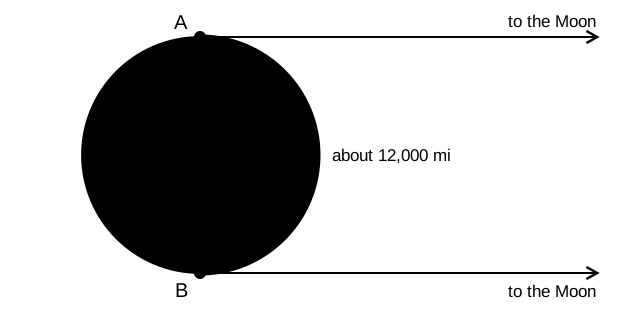
Key Information: The approximate maximum EME separation measured along Earth’s surface is 12,000 miles, if the Moon is “visible” by both stations.
Flutter and Distance #
Even with both antennas aimed at the Moon, the returned signal can flutter. Different parts of the Moon’s rough surface return energy over slightly different paths. Earth and lunar motion keep the Moon’s apparent orientation rocking slightly, a motion called libration. That motion gives the returns slightly different Doppler shifts, so their contributions alternately reinforce and cancel.
Key Information: Libration fading of an EME signal is characterized by a fluttery, irregular fading.
At VHF, those Doppler differences are too small to hear as a change in pitch.
Lunar distance offers a more predictable advantage. Perigee is the nearest point in the Moon’s orbit; apogee is the farthest. A nearer reflector reduces spreading on both legs of the trip. Each leg’s loss grows with the square of distance, so the round trip’s grows with the fourth power. Perigee is about 10 percent closer than apogee, which saves about 2 dB.
Key Information: When scheduling EME contacts, the least path loss generally comes when the Moon is at perigee.
On a lunar calendar, look for the perigee date. A full Moon describes the lit face we see, not the distance; the “supermoon” in the news is a full Moon that falls near perigee.



 The E region