

Section 6.5: Electrically Short Antennas #
A full-size quarter-wave vertical for 40 meters stands about 10 meters (33 feet) tall. A loading coil lets a mobile whip a fraction of that height resonate on the same band, yet the whip may turn most of the power it accepts into heat. The efficiency ratio from Section 6.1 shows why, and what helps.
Resonance Without Full Size #
A base-fed whip used below its natural resonant frequency is electrically short and has capacitive reactance. The lower the frequency, the smaller a fraction of a wavelength the same whip becomes, and the less it radiates for a given current. Loss resistance then makes up a larger share of the total.
Key Information: The radiation resistance of a base-fed whip antenna decreases below its resonant frequency.
For example, a radiation resistance of 2 Ω with 8 Ω of loss gives efficiency. If radiation resistance falls to 1 Ω while losses stay at 8 Ω, efficiency drops to . Low feed resistance by itself does not signal good performance.
A loading coil in series supplies inductive reactance. If the whip presents , a coil supplying at the design frequency brings the net reactance to zero. The coil stores magnetic energy; it doesn’t replace the missing length of radiating wire. Its resistance also dissipates power, so lower resistance gives the same tuning with less heating.
Key Information:
- The function of a loading coil in an electrically short antenna is to resonate the antenna by cancelling the capacitive reactance.
- Antenna loading coils should have a high ratio of reactance to resistance to maximize efficiency.
That ratio is the coil’s Q, the series from Section 2.4. A coil supplying 200 Ω of reactance with 1 Ω of resistance has a Q of 200. The same reactance with 4 Ω of resistance gives Q 50 and four times the loss.
Moving Current Up the Radiator #
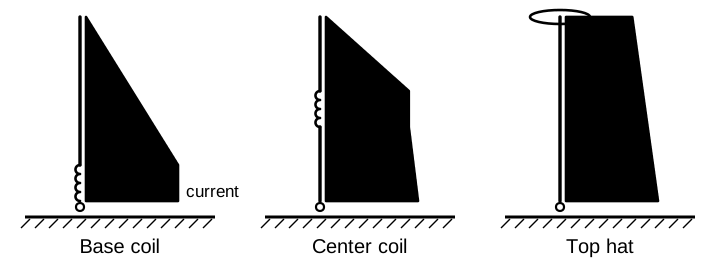
With the coil at the base, the current in the whip above it falls steadily to zero at the tip. Moving the coil upward lets the whole lower section carry nearly full current. More current over more of the height radiates more power for the same feed current, which raises radiation resistance and with it the efficiency ratio. Too near the tip, the coil needs much more inductance, adding loss.
A capacitance hat, also called a capacity hat, is the usual form of top loading. Its conducting area at the top keeps current high along nearly the whole vertical portion. It also reduces the inductance needed for resonance, so coil loss falls. The support must carry the hat’s weight and wind load.
Key Information:
- Near the center of the vertical radiator is the most efficient location for a loading coil on an electrically short whip.
- An advantage of top loading an electrically short HF vertical antenna is improved radiation efficiency.
A Narrow Match #
Mobile HF operators often retune after moving only a short way across a band; on 75 meters, a few tens of kilohertz can be enough. A small loaded antenna stores much more energy than it radiates or loses each cycle, which gives it a high antenna Q. Its reactance changes quickly away from resonance, as in any high-Q resonant circuit.
Key Information:
- As the Q of an antenna increases, SWR bandwidth decreases.
- When one or more loading coils are used to resonate an electrically short antenna, SWR bandwidth decreases.
Coil Q and antenna Q answer different questions. A coil’s Q compares its reactance with its own resistance, so higher is better. Adding any resistance lowers antenna Q, which widens the SWR curve, but only by turning more of the power into heat. By that measure, a dummy load is the broadest-band antenna of all.




 Radiation resistance decreases